
Built for drug safety. Enhanced by AI.
AI is already changing how safety teams identify adverse events, process cases, review literature, detect signals and prepare regulatory reports. But speed alone is not enough — patient safety, regulatory compliance, traceability, signal validity and human oversight remain essential. It is not simply about learning AI tools. It is about learning how to use AI within the standards of drug safety.
Use AI to support adverse event intake, case processing and coding.
Explore AI-supported literature monitoring, surveillance and signal detection.
Judge AI outputs for reliability, compliance and explainability.
Build capability you can use in practice.
By completing the full progression — through to Black Belt — you'll develop the ability to:
One certification. Four levels of capability.
Start with the foundations and progress as far as your professional goals require.
Where could AI change the way you work?
The full range of applications below reflects capability developed across the complete progression to Black Belt.
Support extraction and structuring of relevant safety information from unstructured sources.
Assist with classification, summarisation, coding and prioritisation while preserving mandatory review.
Generate coding suggestions that remain subject to professional verification.
Accelerate screening, relevance ranking and safety-information extraction.
Support identification and prioritisation of potential safety signals across large datasets.
Assist with ongoing safety surveillance, risk identification and documentation.
Support structured drafting and evidence synthesis for periodic safety reports.
Improve consistency and efficiency across expedited and scheduled reporting workflows.
Support inspection readiness, audit trails, quality metrics and compliance monitoring.
For professionals responsible for turning safety data into responsible action.
Demonstrate capability.
Don't just watch videos.
Each belt has scenario-based assessments that require you to apply your knowledge in realistic drug-safety contexts.
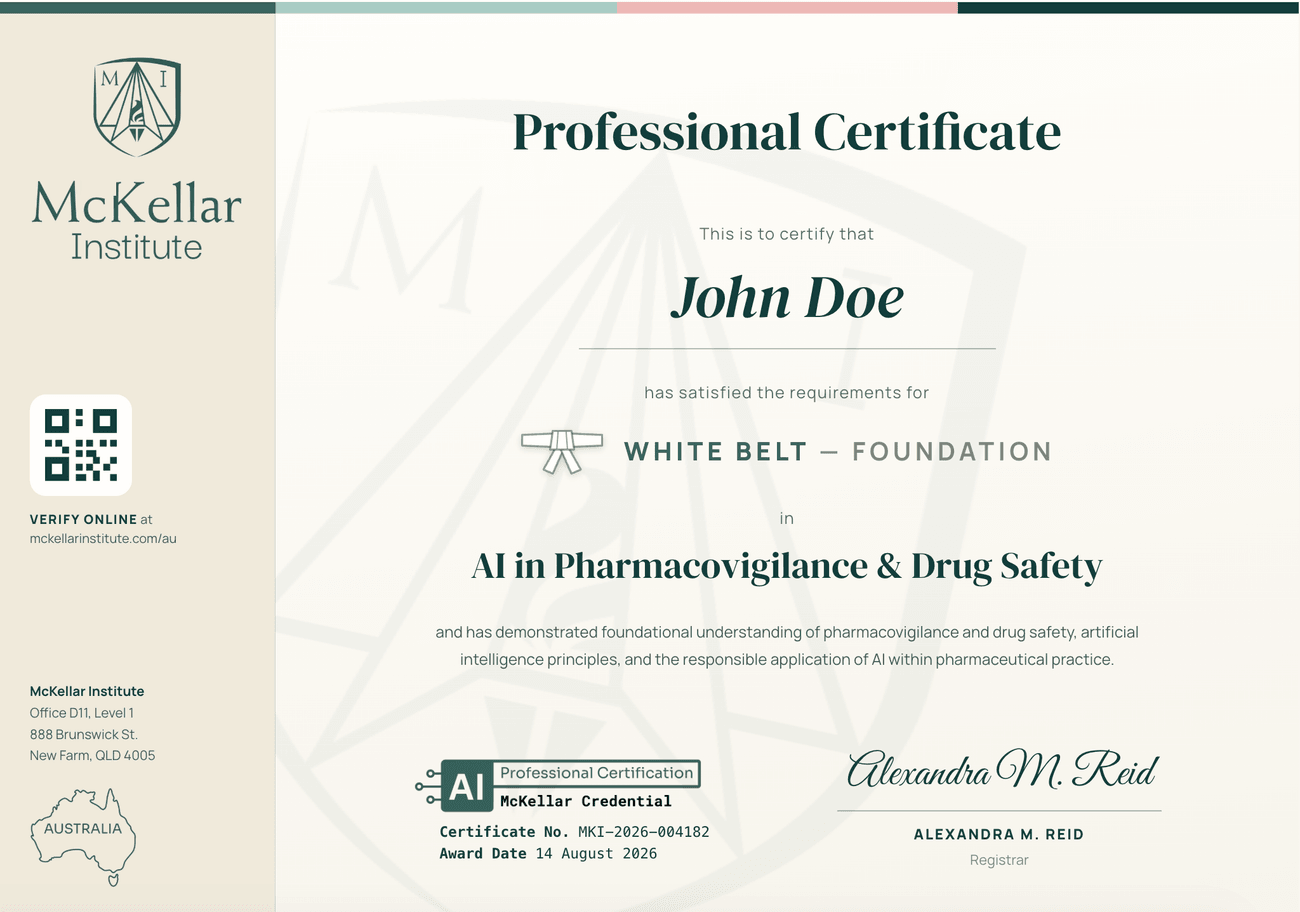
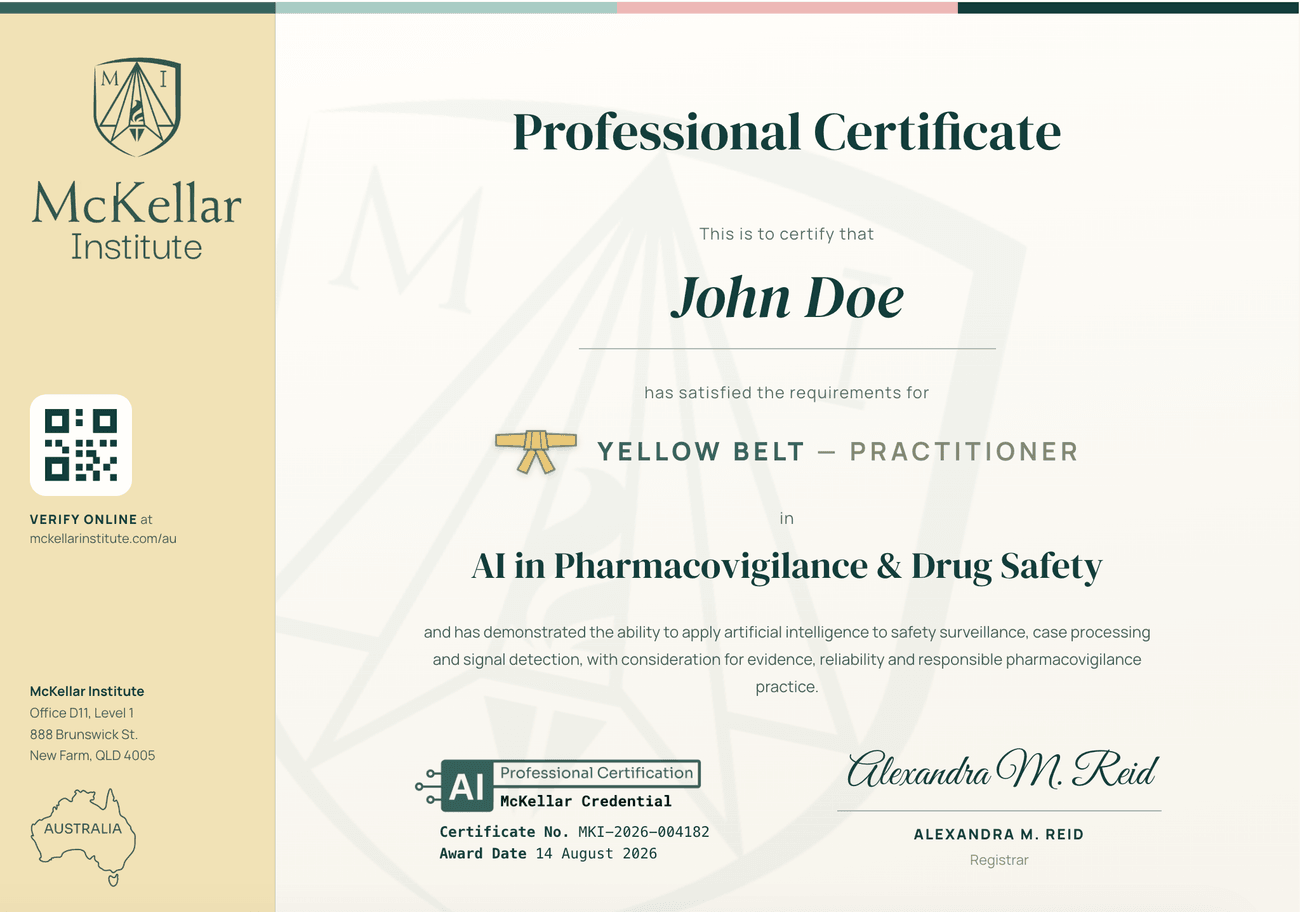
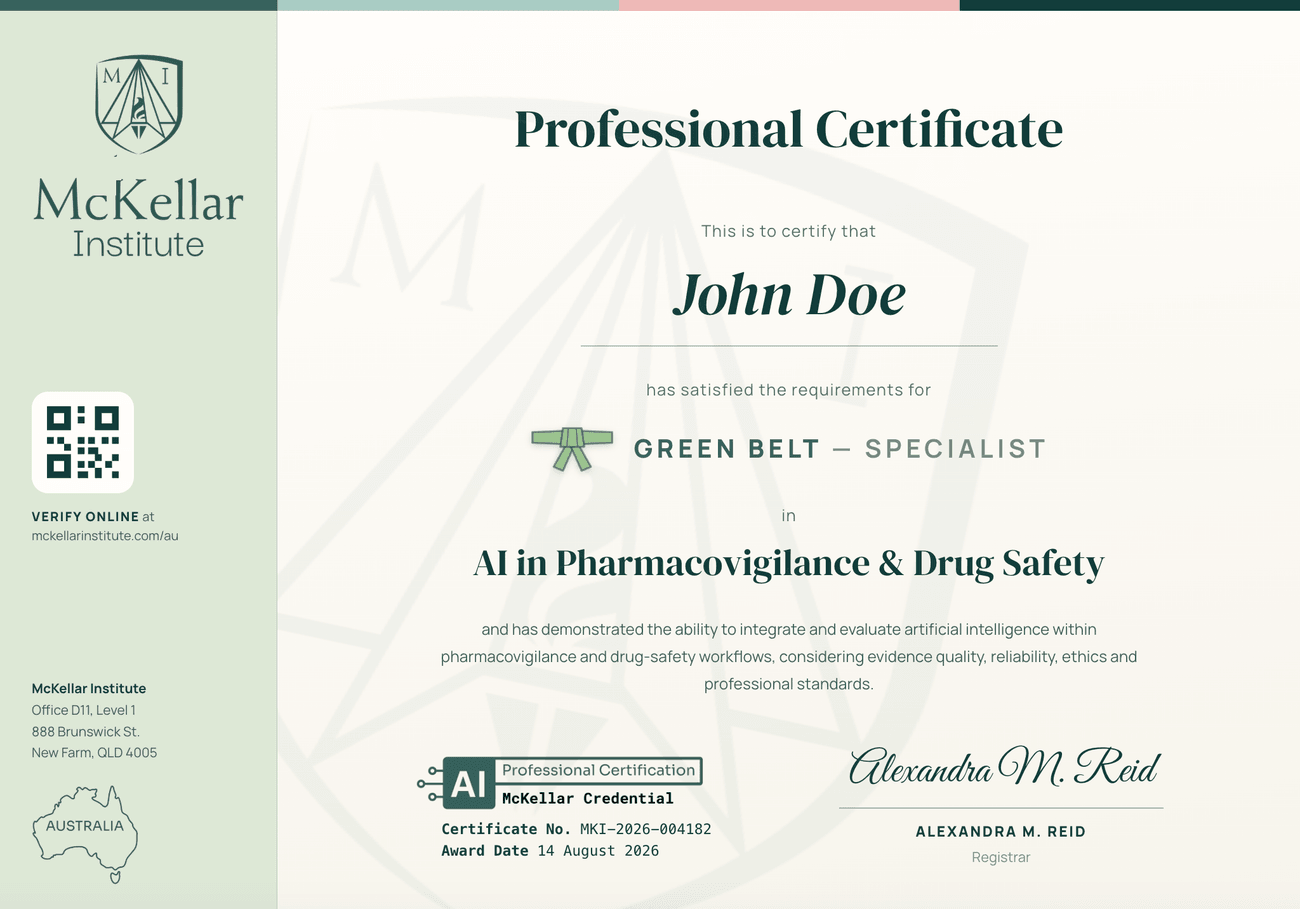
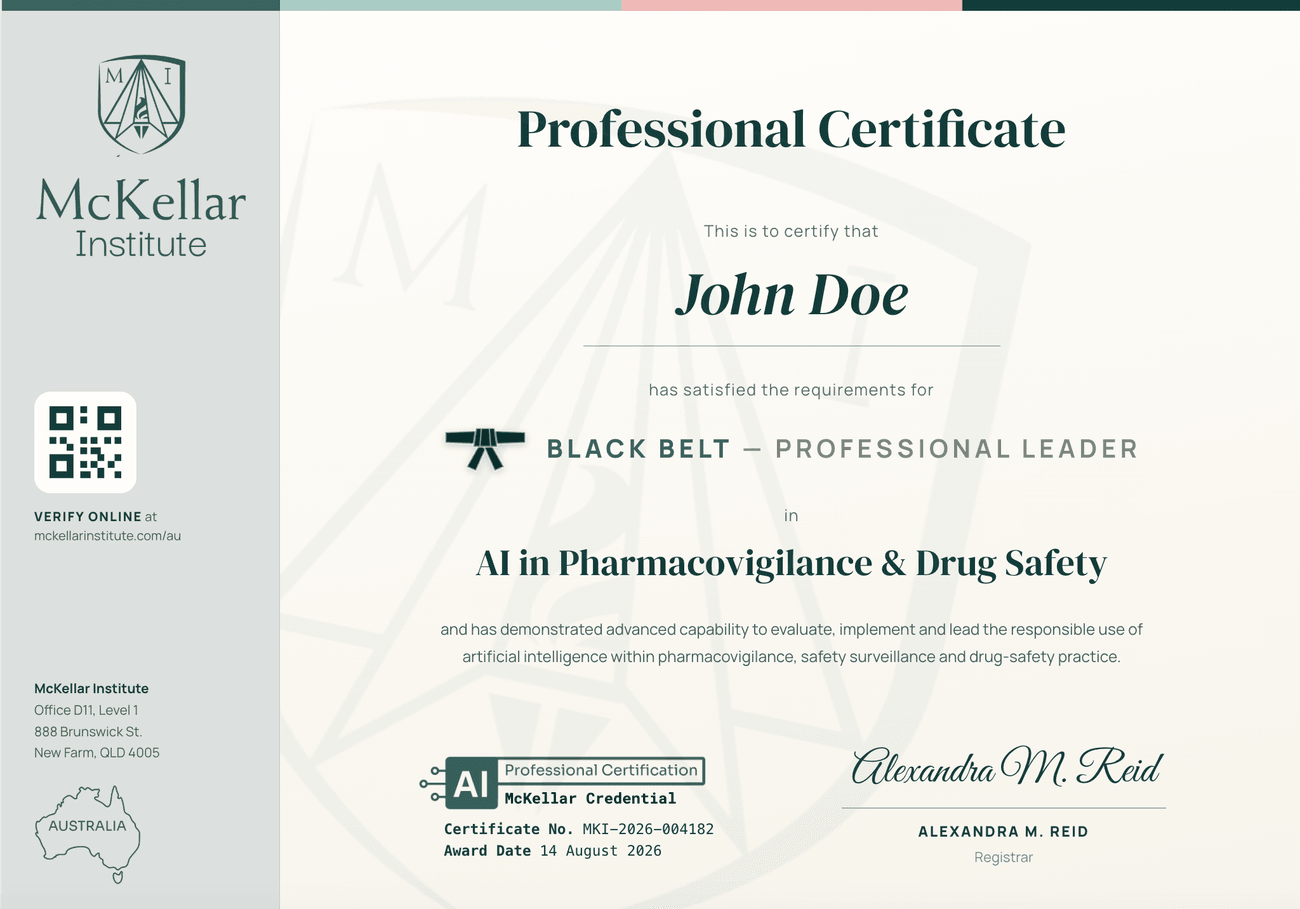
Each belt answers a different question.
Assessment is applied and scenario-based — capability is demonstrated, not attended.
Overall indicative learning effort: approximately 120–165 hours across the full White-to-Black progression.
Start with White. Decide how far to go.
Each price is the fee for that single belt only — you pay per level, as you progress. All fees are in USD.
Pricing varies by country → View your fee
Not sure how far to go?
You don't need to decide today whether you'll complete all four belts.
Regardless of how you pay, every learner begins at White and earns each belt sequentially.
Built for work beyond the classroom.
“The case-processing and signal examples were immediately relevant to my day-to-day safety work. I continued through to Green Belt.”
“It gave me the framework to introduce AI-assisted literature monitoring in our PV team — with the oversight our auditors expect.”
“Practical, honest about limitations and grounded in real pharmacovigilance practice. The belts build on each other well.”
Illustrative testimonials — to be replaced with real learner feedback.
Take the certification guide with you.
Download the complete AI in Pharmacovigilance & Drug Safety guide, including curriculum, learning outcomes, assessment, belt progression and fees.
Download Certification Guide (PDF)Certification-specific answers.
Drug safety is changing.
Build the capability to change with it.
Start with the foundations and progress from understanding AI to applying, integrating and ultimately leading its responsible use within pharmacovigilance.